

Brief History of the family of Shinbukan Dojo (U.K.)
by Jock Hopson Sensei, 7th-Dan Kyoshi (Iaido, Jodo & Kendo)
During a recent conversation with Vic sensei, I began to realise how little the majority of our students probably knew of the history of the Shinbukan in the UK, so this is a modest attempt to produce a potted history.
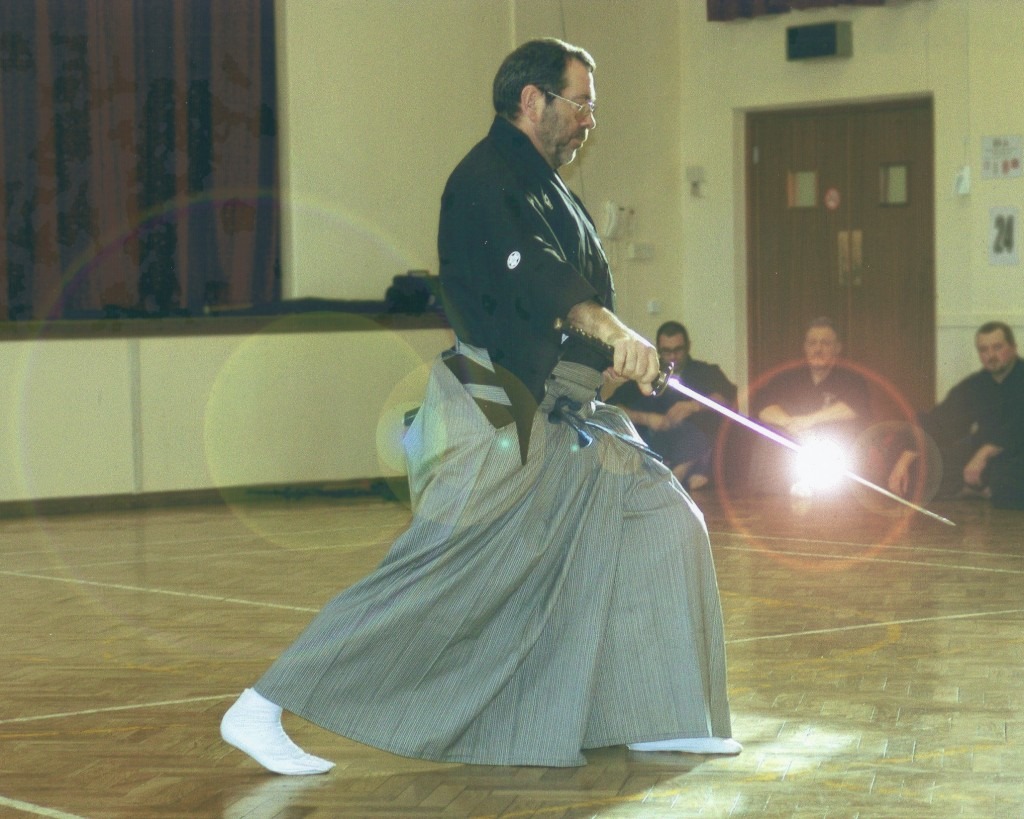
The original Shinbukan Dojo in the UK was a Kendo dojo led by Vic Cook Sensei Founded in Brighton in 1973, in the August of 1979 a relatively young but highly respected lai sensei, Ishido Shizufumi 7th dan Kyoshi visited the UK and at short notice a dojo was needed in which to practice, Vic sensei made his dojo available. On entering the dojo Ishido sensei presumed that the Shinbukan kanji on display were in his honour and was very complimentary as unknown to Vic the Ishido home dojo was also named Shinbukan, a fortuitous coincidence as it turned out. After the necessary explanations were made a link was obviously formed and Vic sensei made the decision to practise lai, a study till then almost unknown in the UK.
On a subsequent visit to Japan when Vic sensei was staying as a guest at the Ishido family dojo, he was searching for a specific mon or badge for the Brighton Shinbukan, Ishido Sadataro, father of Ishido Shizufumi, an lai, Jodo, Kendo and Jukendo sensei of high renown took Vic round all the mon stores in Tokyo to find the item he wanted but to no avail. Ishido Sadataro sensei then made the astounding and generous offer of offering Vic sensei use of the Ishido family mon as he was his sons personal student, this is an honour almost unheard of and is a privilege now jealously guarded by the Shinbukan throughout Europe.
During the following years former students of Vic sensei began to study lai and requested that their own dojo could fall under the Shinbukan banner, requests that sensei was happy to comply with following the approval of Ishido sensei. Over the years the SBK family has grown, mainly through southern and south-east England and later through invitations to teach lai and Jodo in the old Communist Bloc countries namely the Czech and Slovak Republics, Hungary, Serbia and Poland, there are now flourishing Shinbukan dojo in all of these countries. All these dojo have virtually the same constitution as the Shinbukan in Japan apart from some minor local differences, but it must be stressed that we as individual members have no immediate link with Japan, our direct allegiance is to Vic Cook sensei who is a tokubetsu mojin or ‘special’ student of Ishido sensei, Vic sensei has a small number of tokubetsu monjin of his own in Europe but their students again have no direct link to Vic sensei, their allegiance is to their own dojo sensei. A handful of dojo leaders therefore are direct students of Vic sensei but not of Ishido sensei no matter how often they might have practised under him, their own students are not students of Vic sensei despite training under him on occasion but are responsible to their respective dojo leaders. Basically, the hierarchy or structure of the old Japanese clan system slightly modified for modern usage, a little strange perhaps to those not familiar with Japanese social customs but basically “everything in its place and a place for everything”.
Our policy is to act as correctly as we are able and this means attempting to follow Japanese customs where possible while accepting that we are not Japanese, mistakes will be and are made but hopefully we learn from them. Duty and obligation is a major facet of the Japanese social system and something not appreciated in the West, the giving of reciprocal gifts, often envelopes of cash, is an essential part of the structure and is just one of the many obligations that being a Shinbukan member entails but is not fully recognised or understood by the majority of members. An example of this attitude is when Ishido sensei came upon ill health and it was realised between his Tokubetsu monjin that we agreed to support him as his physical prowess was now diminishing therefore we all agreed that the dojo that were in the Ishido lineage under would all contribute an agreed sum every year so that our sensei would not go without due to his being forced to slow down, If someone is prepared to give their time and teach they are making an obligation to you which must be honoured in return, Budo is not a coaching system or a sport but a way of living and the Teacher / Student relationship an essential and integral part, monies given to sensei is not a salary but an acknowledgement of the obligation made by them to accept you as students. Sensei and senior students have and will spend large sums of private monies in order to pass on their knowledge, and we have a duty and obligation to accept and recognise this system and not to just pay it lip service, studying Budo will cost not only time but also money! I have purposely kept this discussion to western terms instead of using the more correct terms ‘On’ and ‘Giri, loosely translated as duty and obligation because then one gets mired in the minutiae of the Japanese language which I am no way qualified to discuss.
Please understand that we study one of the last classical martial disciplines and all that goes with it, talk about this within your own dojo, try and discuss any misunderstandings, leaders tend to take too much for granted and deep down are only human so will make mistakes and assume too much!!
ZenShinZenRei Dojo – ShinBuKan (Bognor Regis) & Bognor Regis Zen Judo Family Dojo
MARCH 2004
Bognor Regis Zen Judo Family dojo is part of The Zen Judo Family (ZJF), a traditional style of Judo established in 1974 and is affiliated to The British Zen Judo Family Association (BZJFA); Kenshindoryu Nippon Budo Kyokai and the International Gentle Arts Society (IGAS). The Bognor Judo dojo was started by Sensei John Robertson on the 1st of March 2004 with only 3 students and Martin Robertson was one of his assistant instructors. (All originally members of Felpham Zen Judo Family dojo before it’s closure). The first training session on a very small 18 x 18 foot canvas mat. It was quickly decided a much larger training area would be required.
APRIL 2004
A month later the club took delivery of a 21 x 30 foot canvas, and the first full training sessions were held on 5th April 2004, with around a dozen students present.
Bognor Regis Zen Judo Family dojo is still active today, with Judo practiced in a nurturing non-competitive environment. We aim to build ability and confidence, each individual progressing at their own speed, with an emphasis on relaxed co-operation. Judo, which means ‘Gentle Way’, should be about technique rather than strength, yielding to use the strength used against you, and that is what we try to learn. The Zen Judo Family syllabus is based upon traditional martial arts training where the focus is on mastering technique rather than focusing upon competition. For more information about the Zen Judo Family and its affiliations visit our Links page.
JANUARY 2014
Martin Robertson joined ShinBuKan (Portsmouth) Iaido dojo, originally under John Piper Sensei (5th Dan) Iaido, to widen his martial arts understanding and supplement his budo training.
MAY 2015
29th May 2015 Bognor Regis Zen judo family dojo became the Hombu dojo of the Zen Judo Family after the closure of Petersfield Zen Judo Club.
AUGUST 2017
John Robertson Sensei Go Dan (5th Dan) Judo was promoted to head of the Zen Judo Family, and soon after achieved his promotion to 6th Dan.
FEBRUARY 2025
ZenShin ZenRei Iaido dojo was started by Martin Robertson, by this time a ZNKR Iaido Shodan (1st Dan) and ZJF Judo Godan (5th Dan). As an assistant instructor at Bognor Regis Zen Judo Family dojo for over twenty years, with over thirty-five years of Judo experience, and eleven years of Iaido training, the initial aim was to pass on Iaido training knowledge to existing judo dan grades at Bognor Regis Zen Judo Family dojo and to expand their understanding of budo, under the insurance of the ZJF.
Since its formation in 2025 students of ZenShin ZenRei dojo regularly attend the weekly sessions held at ShinBuKan (Portsmouth) Iaido dojo, under the instruction of Roger Pilmott Sensei Yon Dan (4th Dan) Iaido & Kendo and Martyn Knight Sensei Yon Dan (4th Dan) Iaido.
Over the years Martin Robertson has attended BKA National Iaido Seminars, as well as International EKF/SKF Iaido Seminars/Gradings, and visited Iaido dojos in Slovakia.
FEBRUARY 2026
In February 2026 Martin Robertson, with the permission of Roger Pilmot Sensei Yondan (4th Dan), current sensei of ShinBuKan (Portsmouth) Iaido dojo, approached Vic Cook Sensei Nanadan (7th Dan) Renshi asking permission to carry on the name ShinBuKan at the dojo in Bognor Regis.
With permission gained, and the subsequent successful European grading by Martin to Nidan (2nd Dan) in Iaido, ZenShinZenRei dojo – ShinBuKan (Bognor Regis) was born, further extending the history of ShinBuKan in the UK. Soon after ShinBuKan (Bognor Regis) officially became an official dojo of the British Kendo Association and benefits from the additional guidance of Martyn Knight Sensei, where we teach both ZNKR Seitai and Muso Shinden Ryu Iaido Katas.
Through the influence of Roger Pilmott Sensei in Portsmouth, Kendo kata and kihon (Fundamentals) with bokuto (Wooden Sword) has also become a regular addition to training at the Bognor Regis dojo.
As such the formation of ZenShinZenRei dojo – ShinBuKan (Bognor Regis) has come about from years of influence by Sensei from ShinBuKan, the British Kendo Association, and the Zen Judo Family. It would also like to extend its thanks those in the European Kendo Federation for their time and patience, and gratitude to Sensei Robbie Kulcsar Godan (5th Dan) Iaido, of Shin JunSui Dojo (Kosice, Slovakia) for his continued personal support and guidance over the years.
Our Dojo Mon (emblem)
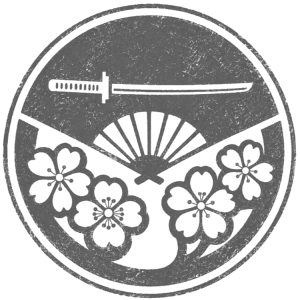
The Tsuba (Sword Guard) style shape of the emblem represents an allegiance to the dojo and to the way of the sword. There is also a duty to protect the reputation of the dojo, ShinBuKan, it’s membership and associated organizations through actions and deeds.
The Snseu (Folding fan) represents Suehiro “Spreading towards the end” and symbolizes the new life of our dojo and the hope of prosperity for the dojos’ future.
The Japanese sword on our Dojo mon is representative of the Japanese martial art of Iaido the dojo practices, but also the embodiment of the virtues of honor, duty and discipline, in which we strive to uphold.
The Sakura (Cherry Blossoms) represent “Mono no aware” – The beautiful, bittersweet awareness that life is short and precious. On our dojo mon this also symbolizes the iaidoka who train and teach within the dojo. Each will leave their mark in their own way contributing to the continuation of the dojo and the ShinBukan organization. (This may be for only for a few sessions, or through decades for dedicated practice).
Our Dojo Idiom (Expression)
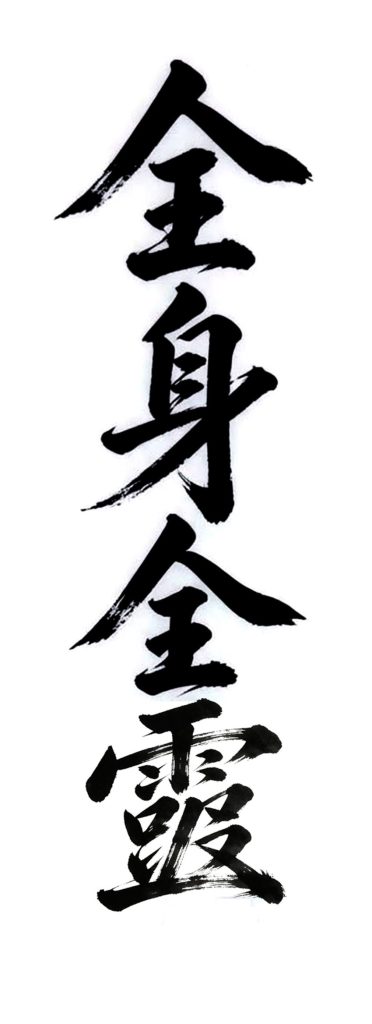
Zen Shin, Whole Body. Zen Rei, Whole Spirit.
So ZenShinZenRei literally means; “With all ones might” or “Body and Soul” or;
To signify total commitment by pouring your whole being – body (Zenshin) and spirit (Zenrei) – into an endeavor.
“The Japanese four kanji idiom, ZenShinZenRei has always held a special place for me as not only as an ethos for continued training within the dojo but also for tackling the challenges of life in general. The hope is that through continued Martial Arts training it will help you to find a path through life that is not only beneficial to yourself, but also to those around you.”
Martin Robertson
Nidan (2nd Dan) Iaido
Godan (5th Dan) Judo